
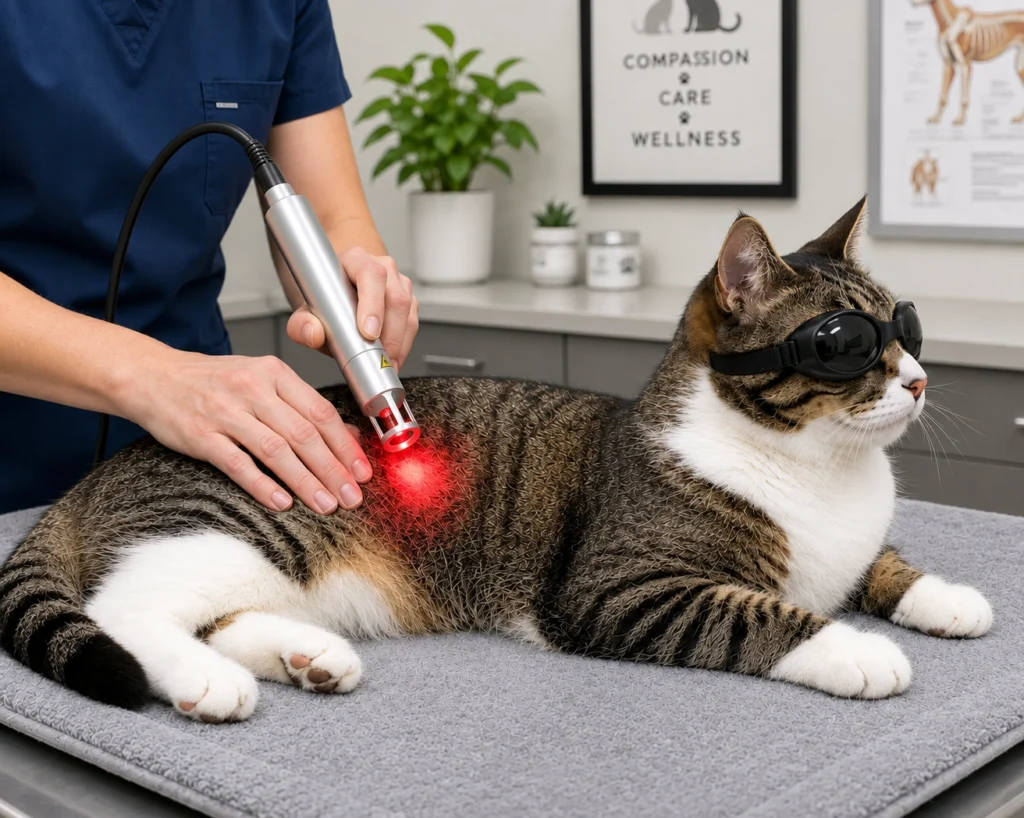
A cat that is quietly sore rarely announces it the way a dog does. Cats hide pain as a survival instinct left over from their wild ancestors, so an arthritic hip or a slow-healing wound often shows up as small changes, a cat that jumps less, grooms less, or spends more time tucked away, rather than an obvious limp. Laser therapy for cats has become a valuable option for these quieter cases, because it treats the underlying discomfort directly without a pill to hide in food or a recovery period that stresses an already anxious cat.
The treatment uses focused light energy to calm inflammation and speed tissue repair, and it does so without sedation, needles, or medication. That matters for cats in particular, since so many feline patients tolerate handling and travel to the clinic poorly to begin with, and a fast, low-stress session fits their temperament far better than a daily pill regimen ever could.
This guide explains how laser therapy for cats works, which conditions it helps most, what actually happens during a session, and how to tell whether your cat might be a good candidate.
What Is Laser Therapy for Cats
Companion laser therapy at Eagle Animal Hospital uses the same class of therapeutic laser already used for canine patients, adjusted in dose and handling for a cat’s smaller size and lower stress tolerance. The device delivers deep-penetrating light into the treated tissue, where it is absorbed by cells and used to accelerate the body’s own healing response rather than to mask pain the way a medication does. The Merck Veterinary Manual states that laser therapy may reduce pain, relax muscles and improve circulation, and it calls the effects of light on cells and tissue photobiomodulation.
Because the treatment involves no incision, no anesthesia, and no injection, it is often introduced for cats that cannot tolerate long-term anti-inflammatory medication, including many older cats with reduced kidney function. It is used alongside, not instead of, any medication or supplement plan your veterinarian has already recommended.
Cat laser therapy sessions are also shorter and quieter than a typical dog session, since most cats settle faster in a dim, low-traffic exam room than in an open treatment area, and the practice adjusts the setting accordingly. The evidence in cats is limited. A 2024 case report in Veterinary Record Case Reports noted that there were no published reports of photobiomodulation therapy in cats, and it described discomfort and behavior changes, presumably thermal skin injury, in three cats with osteoarthritis after a first low level laser session, so settings need to be chosen carefully for each cat.
How Laser Therapy Works in the Body
The underlying science is called photobiomodulation, meaning specific wavelengths of light change how cells behave once the light reaches them. In practical terms, this produces three effects veterinary teams look for: faster cellular energy production that speeds tissue repair, increased local blood flow that delivers oxygen and nutrients to the injured area, and a measurable drop in inflammatory signaling that reduces pain.
Because cats are smaller and their tissue is thinner than a dog’s, the laser’s depth of penetration reaches joints and soft tissue with a shorter session time. The effect builds with each visit rather than appearing all at once, which is why a course of sessions, not a single treatment, is how most cats see lasting benefit.
Conditions That Benefit From Laser Therapy for Cats
According to the protocols followed at our hospital, cat laser treatment is most often recommended for the following conditions.
Arthritis and Joint Stiffness in Cats
Feline arthritis is widely underdiagnosed because cats compensate so well. A cat with a sore hip does not limp the way a dog does. Instead, it stops jumping onto the counter, hesitates at the top of the stairs, or starts using a litter box with lower sides. Laser sessions reduce inflammation in the joint capsule, which for many cats translates into jumping and climbing again without the same hesitation.
Post Surgical and Spay or Neuter Recovery
Following a spay, neuter, or other procedure, laser therapy reduces swelling around the incision and supports faster tissue closure. In dogs, a 2024 randomized trial after knee surgery found promise but no statistically significant difference, so the benefit after surgery is not settled. Many owners pair a laser session or two with the standard post-surgical recovery plan their veterinarian outlines at discharge, particularly for cats that seem unusually sore or slow to bounce back.
Wounds and Cat Bite Abscesses
Outdoor and indoor-outdoor cats commonly develop wounds from territorial fights with other cats, and these bites frequently become abscesses under the skin. Once an abscess has been drained and cleaned, laser therapy at the site supports faster tissue regeneration and helps close the wound with less scarring than it would otherwise leave behind.
Dental Discomfort After Extractions
Cats develop resorptive lesions and stomatitis at much higher rates than dogs do, and both conditions often end in tooth extractions. Laser therapy applied to the gum tissue after an extraction eases swelling and appears to help cats resume normal eating sooner, which matters for a species that can develop serious complications from not eating for even a day or two. This pairs naturally with the care outlined on our dental services page for cats recovering from oral surgery.
What Happens During a Cat Laser Therapy Session
A cat laser therapy session is brief and designed around feline comfort, since a stressed cat undoes much of the calming benefit the treatment is meant to provide.
| Step | What Happens |
| Settling in | The cat stays in a quiet exam room, often on a towel from home, to keep stress low before treatment starts |
| Protective eyewear | Small protective goggles are placed on the cat and on staff, since the laser light is bright |
| Treatment | A handheld laser is moved gently over the treatment area for one to a few minutes per site |
| Comfort check | Most cats relax noticeably from the warmth partway through, and a few begin to purr |
| Wrap-up | No sedation or recovery time is needed, and the cat can go home and resume its normal routine right away |
There is no shaving, no needles, and no anesthesia involved. Owners are welcome to stay nearby during the appointment, which tends to keep anxious cats calmer than being left alone in an unfamiliar room.
How Often Cats Need Cold Laser Therapy
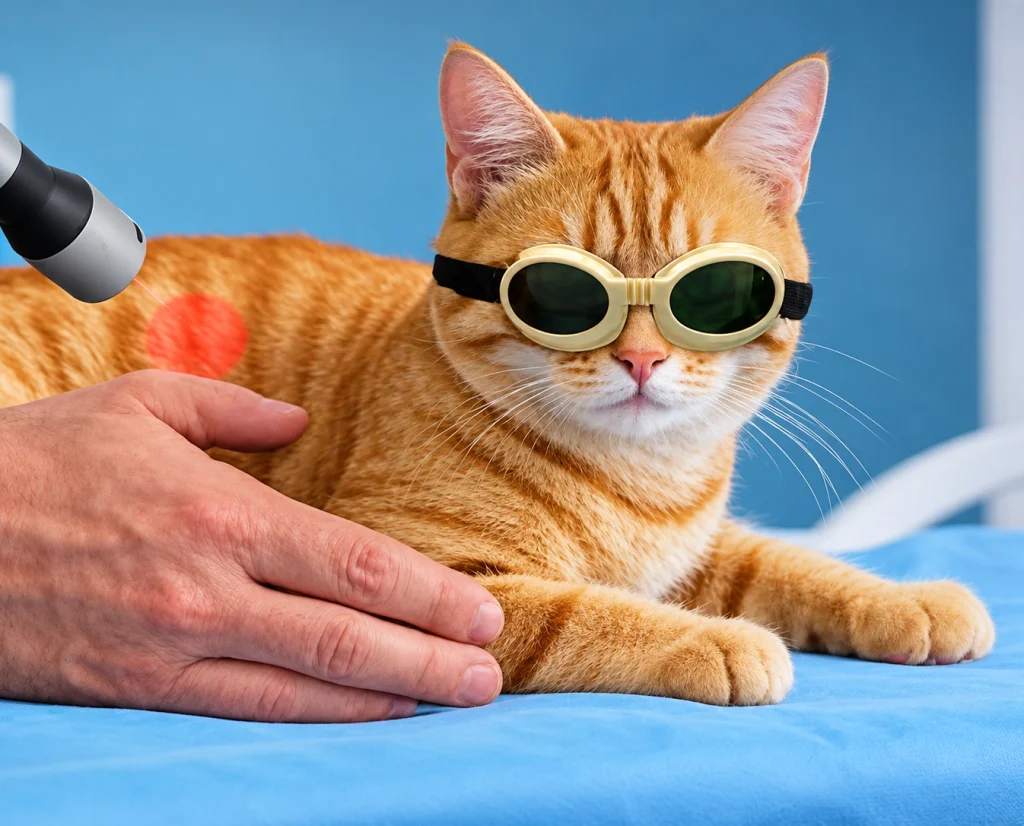
Session frequency depends on whether the condition is a short-term injury or an ongoing one. Acute injuries, wounds, or post-surgical cases usually call for more frequent sessions in the first one to two weeks, then tapering off as healing progresses, while chronic conditions such as arthritis typically start with an initial series of sessions over several weeks, followed by maintenance visits spaced out based on how well the cat is responding.
Most owners notice some improvement within the first two or three sessions, though cold laser therapy for cats works cumulatively, meaning the full benefit typically builds over several visits rather than showing up immediately. Your veterinarian will set a schedule based on your cat’s specific diagnosis, age, and overall health.
Is Laser Therapy Safe for Cats
Laser therapy is considered one of the safest supportive treatments available for cats because it does not involve medication, sedation, or invasive handling. A few precautions apply regardless of species: both the cat and staff wear protective eyewear during treatment, the laser is not applied over known tumors or directly on pregnant cats without specific veterinary guidance, and the laser is never directed at the eyes. Merck lists further cautions: laser should avoid areas of cancer, an overactive thyroid gland, areas of active bleeding, the retina and a pregnant uterus, and higher powered Class IV units can heat tissue.
Because there is no medication involved, laser therapy can be used safely alongside a cat’s existing prescriptions, including thyroid or kidney medications common in older cats. This makes it a reasonable option for senior cats who may already be managing several conditions and cannot take on much additional medication. Cats receiving ongoing laser sessions are typically monitored through the same regular wellness exams used to track any senior cat’s overall health.
Signs Your Cat May Benefit From Laser Treatment
Because cats mask discomfort so effectively, it helps to know the quieter signs worth mentioning to your veterinarian:
- A cat that used to jump onto furniture or counters without hesitation but now avoids it or hesitates first may be managing joint pain rather than simply losing interest.
- Taking the stairs one step at a time instead of moving normally can signal stiffness or discomfort in the hips or knees.
- A noticeable drop in grooming that leaves the coat matted, greasy, or unkempt often points to pain that makes twisting or stretching uncomfortable.
- Spending more time hiding or sleeping in low, out-of-the-way spots instead of favorite perches can be a cat’s way of avoiding movements that hurt.
- Reacting to touch near a hip, shoulder, or the base of the tail, whether by flinching, pulling away, or growling softly, usually means that area is sore.
- A wound, incision, or dental extraction site that seems slow to heal is worth mentioning at a follow-up visit rather than waiting to see if it resolves on its own.
None of these signs on their own means an emergency, but together they often point to pain the cat has been quietly managing on its own.
Building a Long Term Comfort Plan for Cats
For many cats, especially seniors and those with arthritis, laser therapy works best as one part of a broader comfort plan that may also include weight management, joint support, and an environment adjusted for easier access to food, water, and litter boxes. It does not replace these other pieces, but it adds a drug-free option that fits even cats who cannot tolerate additional medication. Owners frequently describe a cat that grooms more, moves more freely, and seems more like itself again once sessions become part of its regular care, which is really the point of a long term comfort plan in the first place.
If your cat is recovering from surgery, living with arthritis, or healing slowly from a wound or dental extraction, it may be worth discussing laser therapy at your next visit. The team at Eagle Animal Hospital in Chester Springs offers companion laser therapy for both dogs and cats as part of our full range of veterinary services. Request an appointment online to find out whether it is a good fit for your cat.
Sources
Merck Veterinary Manual, Photomedicine in Veterinary Patients (updated 2025).
Peer reviewed veterinary reference.
Supports how laser therapy works, the indications and the contraindications and heating cautions.
Barale et al., Veterinary Record Case Reports, Undesired effects of low level photobiomodulation analgesic therapy in three cats with osteoarthritis (2024).
Peer reviewed case report.
Supports the statement that no published reports of photobiomodulation in cats existed and the three cat adverse effects.
Chavez, Renberg and Cernicchiaro, American Journal of Veterinary Research (2024).
Peer reviewed randomized trial in dogs.
Supports the statement that surgical recovery benefit showed no statistically significant difference.
Frequently Asked Questions
Q: Why does laser therapy for cats matter for cats with chronic conditions?
A: It gives cats with arthritis, chronic wounds, or other ongoing conditions a pain-relief option that does not depend on daily medication, which matters for cats that tolerate pills poorly or have health conditions that limit medication choices. The effect builds over a series of sessions rather than requiring an ongoing prescription.
Q: Does laser therapy hurt cats?
A: No. Most cats find the treatment relaxing rather than uncomfortable, and many notice only a mild warmth as the laser passes over the area. There are no needles, no shaving, and no sedation involved, which is part of why it suits cats that already find vet visits stressful.
Q: How long does a cat laser therapy session take?
A: Most sessions run between five and fifteen minutes, depending on how many areas need treatment. Cats can go home immediately afterward with no recovery time or activity restrictions.
Q: How many sessions will my cat need?
A: It depends on the condition. Acute injuries or post-surgical cases often need just a few sessions spaced closely together, while chronic conditions such as arthritis typically start with a series over several weeks, followed by occasional maintenance visits.
Q: Is laser therapy safe for senior cats or cats with other health conditions?
A: Yes. Because it does not involve medication, laser therapy is often a good fit for senior cats already managing kidney disease, thyroid conditions, or other issues that limit their medication options. Your veterinarian will still review your cat’s full health history before recommending a treatment plan.